Search This Blog

Sunday, February 11, 2018

7Day Roguelike 2018: Turncoat Tomb


2018 7 DAY ROGUELIKE CHALLENGE!

https://itch.io/jam/7drl-challenge-2018

If I'm going to write a book on how to make a roguelike using Construct 2, well then I should be able to make a Roguelike using Construct 2 in 7 days and succeed in the 7DRL challenge or else why would anyone want to read my book?


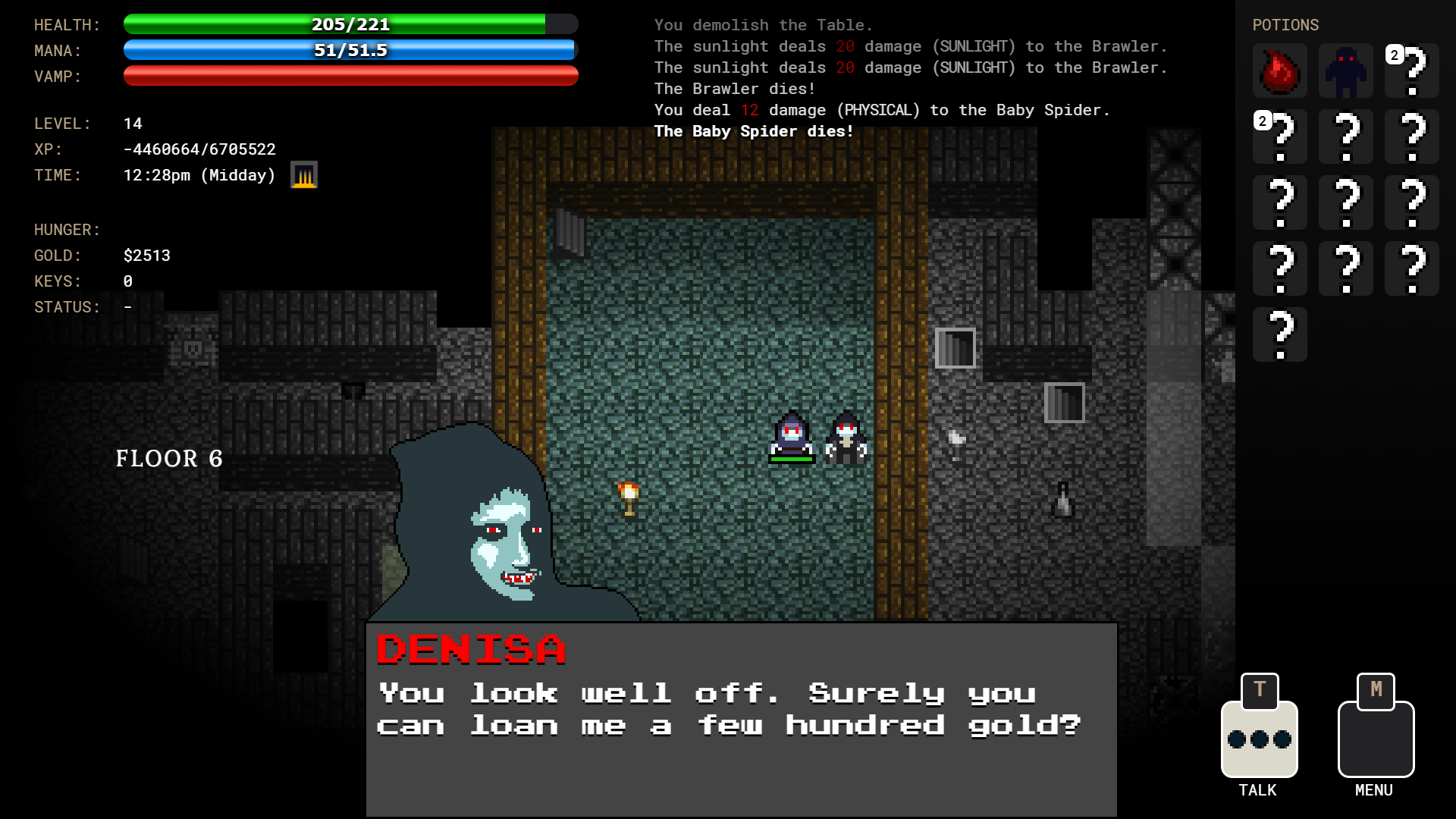
I have been heavily inspired by the game Golden Krone Hotel. One of the things that makes it fun is the idea of factions --Vampires vs Humans.

You can be attacked by a horde of vampires in the middle of bloody combat, then drink some vampire blood and suddenly they'll stop attacking you. Oh you're one of us! It's all good! No hard feelings! And they even talk to you saying things like:

"I killed a man once... Couldn't kill him twice!"

...but then humans will attack you because you're a vampire. I love that whole really simple factions angle and plan to really lean into it with my 7DRL.

What is glaringly missing in this is the fact that human and vampire npcs never attack each other! It's just you for some reason.


I figure NPC humans and vampires don't attack each other because of some pact... kind of like the Continental Hotel in John Wick movies.

Image result for john wick inside the continental hotel


This is where another one of my big influences comes in. A much older one:


CROSSROADS for the Commodore 64.


Now THESE enemies kill the hell out of each other! In fact the first minute of each round is mainly just staying out of the way until the enemies reach a sort of equilibrium leaving you to clean up what's left. The enemies are different colors and the different colors and types hate each other while others can get along. They all hate you, but sometimes it seems somewhat less.


You're not so much participant let alone instigator in the main battle, but more of a bystander trying to survive the harsh ecosystem among the combatants let loose in the maze.

This was a game released as pages and pages of hex data the would be player had to enter by hand into a commodore 64 from Compute magazine in the 1980s and it was absolutely genius.


Imagine if Robotron were in a maze and the robots all hated each other.

So my game will have factions based on color and the enemies will also fight each other like in Crossroads, but leave you alone if you were in their faction (by donning their color) like in Golden Krone Hotel.


There's something magical that happens when you see NPCs fighting each other. From the first time I saw a Berzerk Robot shoot another Robot in Berzerk, to the first time I played HALO and saw the Covenant in the distance fighting the Flood on the snow levels.


Here I am witnessing this battle in the distance that has nothing directly to do with me and I feel more immersed in the world than ever.

My first real encounter with factions outside a war strategy game was Mercenaries: Playground of Destruction.


This game has 4 factions that are always in varying states of hostility toward the player with one special faction, North Korea being always hostile.

This hostility varies based on what you do in the game and some missions, for example fighting Chinese soldiers on a mission from the Russian Mafia will increase how much China hates you, but also increase the friendliness of the Russian Mafia toward you. So you're always juggling the varying factions and their attitude toward you.

Another special faction is civilians, who don't hate anyone, but cost you money in fines if you accidentally harm them.

What seems to be missing, and I could be wrong about this is that the hostility of the factions toward each other is not variable in the same way.


They hate each other or not pretty much without your intervention.

COLORS


In my RL I want to have basically 6 factions:


GREY: The human faction

RED: Monsters

BLUE: Monsters

YELLOW: Monsters

GREEN: Monsters

BLACK: (Shadow/Undead)


Each color will have a corresponding dictionary containing floating point numbers indicating how much they hate each other color.


Magic in TT is heavily geared toward manipulating monsters and their factions. From slightly influencing how they feel about some or other monster faction to switching their faction altogether, joining their faction yourself, or utterly dominating them.


Sunday, November 12, 2017

Golden Krone Hotel and my Zombie Ray Casting Construct 3 Template


Golden Krone Hotel and my Zombie Ray Casting Construct 3 Template


Playing Golden Krone Hotel and it's kicking my ass! 


Those FN Snakes!  It had to be snakes...  But because it's a Roguelike in the truest sense, it always feels like I could have just done something a little different --which keeps me coming back.  When playing on normal and not playing very well, it has addictive feel of pulling a slot machine lever.  Just. One. More. Try...


The soundtrack is immersive and the game just *feels good.  Solid.

I was turned on to it by RogueLike Radio episode 138.

http://www.roguelikeradio.com/2017/08/episode-138-golden-krone-hotel.html

They interview the creator Jeremiah Reid.

It's hard to believe this started out as a 7 day Roguelike.  It seems really big in its scope.   The idea of making a Roguelike that fast with any kind of complexity at all.. I find somewhat intimidating.  Ill have to check out what the 7 day RL was like....

I didn't have to wonder long, because the original 7drl release is still available right here:

http://humbit.com/gkh/gkh-v1.0/index.html


...And it's not at all comfortingly incomplete.  It's a really complete and playable game with the light and dark vampire mechanics in place.  It's a fantastic for a 7drl. 

Anyhow it inspired me to get to work on SOMETHING, because I've been really non-productive game wise the past few weeks.

I'm still working on my Construct 3 RayCasting game template which I would like to release on the Scirra store.


I'm making a zombie shooter as a template with indoor and outdoor areas.   Just walls.  Very old school ray casting.   Pretty cool for a 2d engine though.  


Tuesday, September 26, 2017

Retro 3d fps in Construct 3


*Update... I'm now using actual ray casting for the walls, but still the 2d sprite frames for the other objects like trees and grave stones. 


I made a simple ra-casting style 3d fps "engine" using Construct 3 with no plugins just Construct 3 events and some clever use of sprite animations.

My son wanted to know if I could add 3d capability to a roguelike game for Construct.  I can easily with Construct 2 using the 3js plugins, however

1. Publishing a game to android is a pain for me in Construct 2 and it's a breeze in C3.  Easy peasy.
2.  It's very satisfying to make all the 3d on my own and it have it even work badly.  It works!  I didn't think it would even work.
3.  Threre's a cool really retro feel to it that you don't get with a modern engine.  Something is magical about tricking a 2d engine into doing 3d ish things.


The way it works is I make a block in Milkshape, export it to a direct x object then use a program called "SpriteMe"  which can be seen in action here:

https://www.youtube.com/watch?v=yC05ACgSbtA

and I make it spin 90 degrees and capture about 1 frame for every degree.  This makes a roughly 90 frame animation.   Then with a little math inside Construct 3, it picks the frame depending on the angle it is to the pov.

Combine that with scaling based on the distance from the POV and you have some playable, primitive looking pseudo 3d!

That takes care of blocks but what about things like bullet holes or rounded paintings or small windows?  For those I just make them thinner when you get more of an angle to them.  If you're facing straight on they're wide, if you're looking at them at an angle they get thinner.

After lots of trial and error math it works.

...


Thursday, July 13, 2017

Let's Make A Roguelike with Construct 2 is coming along


Let's Make A Roguelike with Construct 2 is coming along...


I'm on page around 145 now and I'm thinking about taking some things out. I ran into some dead ends, did some things over and some parts just don't fit anywhere. I may have an appendix for these similar to "bonus content" deleted scenes you get on DVDs.

For example I started out using a dictionary data structure to store the player's stuff. This became cumbersome, however since a key/value pair can only easily hold so much information. What if the item was worn out but another identical item wasn't?

Since Construct 2's dictionary object can save itself to a JSON string, I thought hey why not have a dictionary OF dictionaries? The value of a particular Item you have could itself be a dictionary of key value pairs like "name: SwordBlade, worn out ness : 30, cost : 25, damage : 10, etc:etc" for the item "longsword1" or something.

But that got too complicated too fast and in my opinion introduced unneeded clutter and created more problems than it solved. It's not good to give yourself too many options. The data structure might as well be called "can of worms."

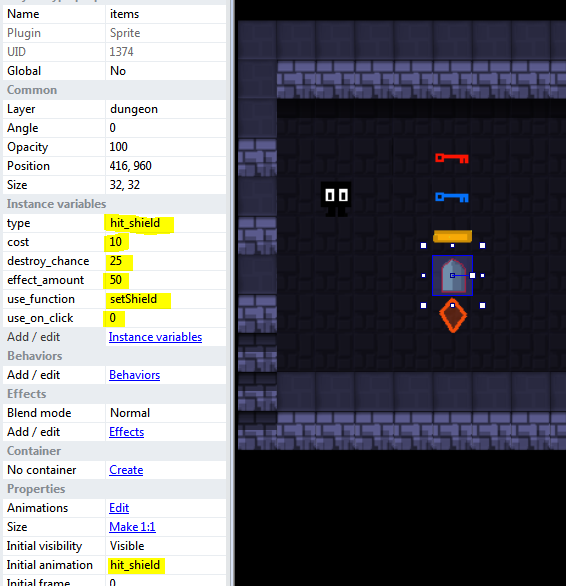
Instead I came up with a way where all the needed values are stored in the "items" sprite and those sprite instances can be stored right there on the HUD. So literally the sprite you pick up is the item in your slot. It's not a sprite that represents the item you are carrying, it IS the item you are carrying.
That way items can be used, have charges, or ammo or whatever and those values are stored for that individual instance with no complicated middle man data structures.

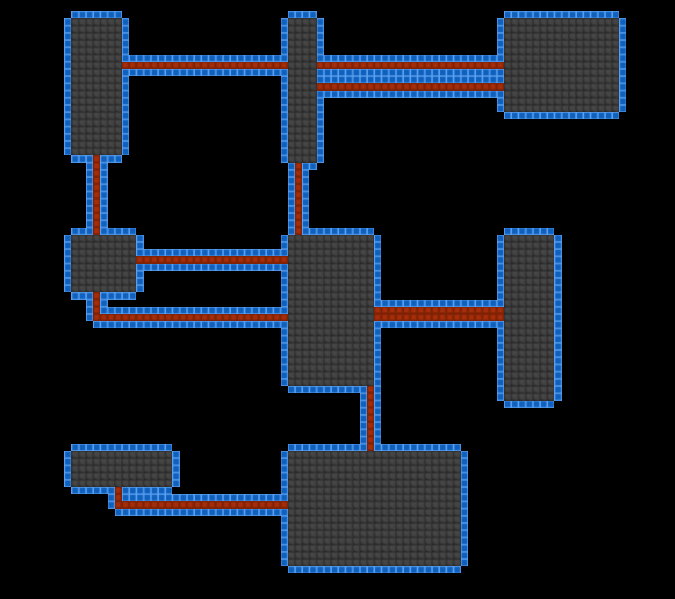
Anyhow page 145 and I still haven't got to the procedural parts yet. First I'm making the game play with a manually generated dungeon. The game should not care how the dungeon is made whether you draw it in construct, use a cave algorithm or lego style grammar based methods.

And thus far it doesn't

Moving right along...

Tuesday, April 25, 2017

Roguelike Radio: Episode 105: Dungeon Hacks, a book about roguelike...

Roguelike Radio: Episode 105: Dungeon Hacks, a book about roguelike...: This is episode 105 of Roguelike Radio, where we discuss Dungeon Hacks , a book on the history of roguelikes by David Craddock .

Monday, April 24, 2017

Back to working on my book and still listening to RogueLike Radio

I just listened to the episode with David Craddock, author of "Dungeon H@cks:..."(see below) and really the one who inspired me to begin writing "Let's Make A RogueLike with Construct 2" in the first place.  That and "Stay A While..." are some of my favorite books on the subject.

Dungeon Hacks: How NetHack, Angband, and Other Roguelikes Changed the Course of Video Games by [Craddock, David L.]

Dungeon Hacks at Amazon

What really got me started was making this simple tutorial I called "RogueLike Random Maze Tutorial" which just showed Construct 2 users how to make a simple maze and do line of site lighting.

https://www.scirra.com/tutorials/4831/rogue-like-random-maze-tutorial-pt-1

(And looks like I'm using the Stone Soup tiles )  Didn't know it at the time.

It's nothing even as fancy as the original Rogue dungeons, and was more about showing how to use groups and functions.

basic Rogue dungeon with rectangular rooms
I just got done with a modular implementation of the original Rogue "tic tac toe" grid dungeon formula that readers will be able to download and plug in to their own projects.

more varied rooms

odd room shapes and sizes. some inner architecture
By tweaking a few variables, the architecture can vary widely.  The rooms come with room order and it knows where to put doors so the dungeon comes with a built in mechanism for where to put locked doors or barriers.

It's addictive just to hit the space bar and watch a new dungeon pop up and imagine the kind of narrative adventure that is possible in that space and then how to make the program look at it and imagine that same thing.

This is just one of several methods I plan to fully explain:

  • Basic Rogue (with adjustable variation)
  • Room and Hall "agent based" digging method (This is how I first thought to do it with no background and it's still my favorite)
  • Pre-cooked room and corridor "lego" method.  This one you can hand-craft your rooms and lay them out procedurally.  I like this method too.
  • Berzerk Maze Method.  Makes for good labyrinth type areas.  Very fast and cheap.  You could easily have a fast bullet hell type RogueLite with the maze changing in real time with this one.
  • Cellular Automata cave (not my favorite in fact I'm only including it for completeness if I decide to at all)
  • Agent based cave carver method:  Is my favorite because there's no doubt you can get everywhere and you get nice caves.
  • ?? I plan to explore other cavey methods like using a fluid simulation style algorithm.
Also toying with another procedurally generated  "Regions" with the dungeon area to help determine themes and entities.

...and looks like I better give 'em a map.  Gotta have that map.

 But I'm only on the first one as a complete plug-in with nice comments and in any presentably modular and optimized form. And I may start that one over.

Making a book like this is a lot like trying to make a game, in a way this is both,so I have to cull my ideas early and often if I want to get something complete and together.  The readers should have the concepts they need to get started and should be able to use my modules and procedures and make a successful 7drl.

7 Day Rogue Like


That's a decent goal I think.

But I don't want to promise more than I can deliver.  Right now I think it would be a swell book if it were only a guide to a basic game with procedural dungeons, saving with permadeath, items, basic enemies and inventory and some method of attack / health... with only real time shooting mechanics or something.   We'll see where this goes.


Tuesday, April 11, 2017

RogueLike Radio changed my mind about something in my "Let's Make a Roguelike" book!


Roguelike Radio Changed My Mind (and I'm only on the first year)


Still working on my how-to book, Let's Make a Roguelike with Construct 2

Here's an excerpt from my initial draft


...And here's a link to the Roguelike Radio podcast.

http://www.roguelikeradio.com/p/about.html

Apart from consuming everything I can about modern game design and programming patterns, particularly procedural generation, I wanted to uncover more of the mystery about what makes something a good Roguelike and gives players that "Roguelike" feeling.

So I decided to listen to EVERY episode of Roguelike Radio.

I have been immersed in books on game design, level design and the history of video games as well as every GDC or PAX talk on anything to do with Roguelikes I can find... and my favorite resource so far is the Roguelike Radio podcast.

I'm only on episode 18 now and just catching up with 2012.  The podcast is fantastic and even after the first season I'm beginning to unravel the mystery.

The podcast generally 2 or 3 talkers, Darren Grey, Andrew Doull, John Harris, with a special guest developers like Daniel Jacobsen, Nicholas Vining and David Baumgart of Dungeons of Dredmore, or Edmund McMillen of The Binding of Isaac.  They've even had the original creators of Rogue,  Michael Toy and Glenn Wichman.

So far I've learned a few things that make a Roguelike.  The speakers, generally aren't sticklers for turn based play or ascii graphics, but they definitely have things they like and don't like generally.

I know it when I see it


When defining what makes something Roguelike I am reminded of the phrase famously used in 1964 by United States Supreme Court Justice Potter Stewart to describe his threshold test for obscenity:


"I shall not today attempt further to define the kinds of material I understand to be embraced within that shorthand description ["hard-core pornography"], and perhaps I could never succeed in intelligibly doing so. But I know it when I see it..."


But one thing that comes up over and over is the idea that items and weapons should be there to change the way the game is played.  Not and I quote "Trading a plus 2 sword for a plus 3 sword."  This indicates a kind of linear player progression that doesn't really change the gameplay or add real variety.


Same S#$%, Different Numbers


I think it's something I noticed in other RPGs that made me bored and want to quit playing.  I call it the "Same s#$% more hitpoints" effect.

When I played Secret of Mana, a beautiful ambitious RPG for the SNES, after getting higher levels, I realized I was just attacking the same exact things but they just had more hit points and did more damage and I did more damage and had more hit points.  It was basically the same exact thing as the first dungeon, only the decimal point had moved.  Even the higher level spells didn't really change the game much.   They were like the low level spells but did more damage, or healed more... again same stuff different numbers.***


In RPG maker there's even a graph for this progression.


What's the point?  The above graph really soured CRPGs in general for me.  As Ed McMillen said in their interview, "There hast to always be a mystery."

*** This is given a strong caveat that Secret of Mana was in most every way a wonderful game and I got a lot of enjoyment out of it.  As far as SNES expansive for the time RPGs go it's pretty amazing, and was rated exactly that by IGN:  HERE 

So it's not so much THAT game, it's what I believe to be a flaw in the kind of game it is.  The potential for repetitive progression in RPGs in general... and I have run into that same problem in a wide range of games from The Bard's Tale for the Commodore 64 to Borderlands on Xbox 360.

I think there's a point in most any RPG including Dungeons & Dragons when the monsters just seem like numbers and it loses its fun.  Maintaining this fun and mystery is what a good Roguelike can do.
In a random review of Borderlands 2 I found, one blogger said it:

"Fiddlefarting over whether to sell Gun A that does X damage and has Y% of this effect or Gun B which does  X+1 damage but doesn’t have that effect but another is not role-playing...  ...the development curve and sense of progression in the game remains completely screwed up- it’s too long, drawn out, and rewards perseverance and grinding rather than good play and player skill-building. " --Michael Barnes'  blog

This is very close to the same things the Roguelike Radio podcast said in their Diablo episode.  "...If I fail it's because I didn't grind enough." (paraphrasing from memory).

So now that we've identified the problem, what is the solution?

I'm going to have to listen longer to find that answer, but one part of it seems to be having the player not just progress, but change.  In The Binding of Isaac, getting different weapons changes how the player looks and plays dramatically.  It's far beyond adding another +1 to your sword.  Different resources should add variety not just progression.  In a Roguelike, some form of resource management is a major part of the game, and how it is executed is as important if not more so than procedural generation.

So here is my new "big three" list.  Because it's important to have things in arbitrary 3 item lists.  

1. Procedural Generation
2. Permadeath
3. Player Progression  Resource Management


After one season of Roguelike Radio, I have changed my mind about my 3 most fundamental properties of a Roguelike.  Originally I thought that it was 1. Procedural Generation.   (still cool with that one) 2. Permadeath.  (It's important)  3.  Player progression.

But player progression isn't the best way of saying the "roguelike element" I'm trying to describe.

They described a better and I think more essential to the Roguelike experience game mechanic, and dedicated an entire episode to it:

Resource management.

First free clipart I found when I did an image search for "Resource Management."

The combination of things you collect and use should shape how the game plays out as much or more than the random layout of the dungeons or distribution of the monsters.

So I'm changing it to Resource Management, and I have much more to say about it, and I will improve the inventory and skill management parts of the book and sample program.

Yay research.  Only 4 more years of podcasts to go.

As far as the book is going I'm working on several generic dungeon making algorithms:  Traditional "Rogue" rooms and hallways,  Cellular Automata Caves, Agent based level carving, pre-made rooms in bitwise patterns... and more.


...back to work.